
A close reading of Case No. CCPD-OF-0002/1111/2026, Ms. Falguni Maheshwari v. CEO & MD, Air India Limited & Ors.
The recent order delivered by the Court of the Chief Commissioner for Persons with Disabilities (CCPD) in the case of Ms. Falguni Maheshwari vs. Air India Limited is a defining moment in the jurisprudence relating to persons with disabilities in India. The victim is a person with an 80% locomotor disability (spastic triplegia) and is also a user of wheelchair. She was humiliated in being forcibly de-boarded after having occupied her seat in the connecting flight. Even after having completed her journey in her previous flight without any difficulty, arbitrary decisions were made by the officials on issues relating to her being fit to travel and a demand was made for “Fit to Fly” certificate from her without consultation with the airport doctor. This judgment is not just a reprimand of administrative negligence; it is a forceful reiteration that the rights to equality, dignity, and non-discrimination under the Rights of Persons with Disabilities (RPwD) Act cannot be overridden by subjective assumptions.

The Danger of Subjective Medical Assumptions
According to Air India, the ground for offloading the complainant was the health one since she appeared immobile and incapable of verbal communication as well as drooling. Apart from the above facts, the crew said that she seemed to be very tired and had a cold. The fact is that the medical condition of the complainant is spastic triplegia, which is the locomotor disability. To draw the conclusion about medical unfit to fly on the basis of her speech problems and the drooling without conducting the professional medical examination is very inappropriate. There is no medical evidence that proves the correlation between the locomotor disability and the flight-threatening situation. Denying air carriage based on visual, untrained observations by airline staff directly violates the mandatory protocols designed to protect passengers from prejudice.
Reinforcing Objective Criteria
One of the critical aspects of this ruling is its unambiguous emphasis on objective criteria when deviating from the prevailing norms. The DGCA Civil Aviation Requirements (CAR) Para 4.1.36 clearly mentions that “an airline shall not discriminate against a passenger based on his/her disability.” When there are indications that the passenger might be affected with any health problem during the flight, then it becomes imperative that he/she should be personally examined by a doctor and it should be clearly stated whether the person is fit to fly. This judgment further emphasizes that any deviation from these prevailing norms should be done only based on objective criteria. It is also observed that Air India failed to examine the complainant by an airport doctor and failed to give any written reason for refusing carriage as per the CCPD. By penalizing this failure, the judgment reinforces the rule that arbitrary, perception-based offloading is legally impermissible, only objective medical certification is the sole valid threshold.
Compensation vs Fine
The tribunal was particularly mindful of making a distinction between punitive and remedial actions. Statutory fines amounting to a sum total of ₹50,000 were imposed by the CCPD for violating the provisions of Section 89 of the RPwD Act on account of breaching the regulations of safeguarding measures. In addition to such fine, it also directed the payment of ₹5,00,000 as compensation on account of the anguish, pain, shame and financial distress caused to the individual concerned. Though, while imposing punishments is made explicit under Section 89 of the RPwD Act, there is no provision made for the awarding of financial compensation in the RPwD Act.
In ordering the airline to be fined for the non-conduction of the necessary examination and for failure to give reasons in writing when denying boarding a disabled person, the order highlights the importance of having processes followed regardless of how the process ends up with respect to determining whether a passenger is fit to travel. In this sense, the judgement from the Karnataka High Court in the case of PSBB Learning Leadership Academy v. Barnali Rout is a valuable reference in looking at the accountability of private institutions and disability rights enforcement. It is an illustrative case for the exercise of powers by the Disability Commissioner over a private establishment where Justice Suraj Govindaraj ruled that the State Commissioner has the power under Sections 80(b) and 81 of the Act to order a binding corrective directive against a private establishment and directing them to pay compensation as well. The Court affirmed the penalty of ₹10 Lakh imposed upon a private school against the interest of a teacher who got paraplegia and stated that the non-discrimination provision of the Act applies to government as well as private entities. The Court referred to Section 82(2) according to which proceedings by the Commissioner would be considered to be a judicial proceeding. The provisions for the Chief Commissioner in Sections 75-77 are same as that for State Commissioner so the same reasoning supports the CCPD’s authority over a private carrier like Air India. Ultimately, the judgment’s significance lies in strengthening procedural accountability, though its practical impact will depend on the enforceability of the compensation recommendation and effective monitoring of Air India’s compliance.
Effectiveness or Deterrence: An Analysis
In terms of an analysis of the deterrent value, it is necessary to consider whether the combination of a penalty of ₹50,000 and a compensation of ₹5 lakh is an effective means. Section 89 of the RPwD Act provides for a two-level penalty. A first level of breach carries with it a fine not exceeding ₹10,000. Every other breach carries a fine not below ₹50,000 and not exceeding ₹5 lakh. Thus, the former fine of ₹50,000 surpasses the limit for the first breach and also matches the minimum statutory requirement for any further breaches. Such a decision can be understood only in light of the fact that the CCPD found Air India guilty of being a repeat breacher. This can probably be attributed to the previous act by Vistara; which has now been subsumed by Air India. The Commissioner found an earlier award in a consumer forum of ₹1,00,000 against Vistara for denying boarding of a passenger, and that merely providing directions would fail to serve deterrence and accountability purposes. Thus, the fine falls squarely at the level of repeat breach and not the ₹10,000 ceiling.
The decision mentions the judgment of the Supreme Court in Jeeja Ghosh v. Union of India, according to which the technical necessity of the actions does not allow humiliating the passenger. By considering the compensation in terms of public law and as a remedy for violation of the dignity of passengers, the CCPD created a precedent for future cases related to disability rights.
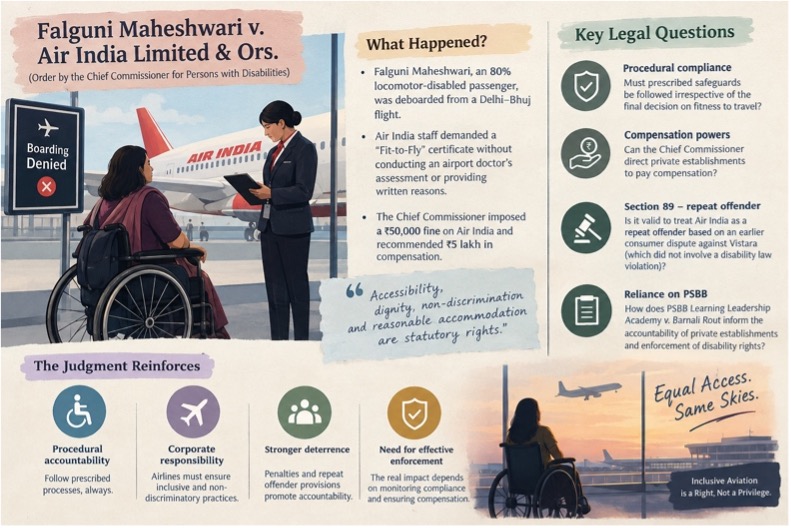
In short, the ruling has been a definite milestone towards inclusive aviation in India. While a monetary fine by itself may not be adequate enough to induce changes within the corporation, the application of objective medical standards, written justification of denial of boarding, and adequate compensation could go a long way in ensuring accountability. The ultimate effect of the ruling will depend on the proper enforcement of disability laws, monitoring of airline compliance, and the adoption of clear procedures.
Read the full order of the Chief Commissioner for Persons with Disabilities (CCPD) here.
Authored by
Pranjal Rastogi, Kanishka Bansal, Khush Yadav and Mahin Ali Khan
5th year students, BML Munjal University School of Law.